
- Home
- Introduction
- 1. Design rights
- 1.1. Design rights: overview
- 1.2. What a design right protects
- 1.3. Why protect a design?
- 1.4. How designs are protected in Australia?
- 2. Application for registration
- 2.1. Application for registration: overview
- 2.2. Registration process
- 2.3. Submitting an application
- 2.4. Minimum filing requirements
- 2.5. Who is entitled to be a registered owner?
- 2.6. Types of applications (s 22)
- 2.7. Request for registration
- 2.8. Further designs
- 3. Fees
- 3.1. Fees: overview
- 3.2. Application fees
- 3.3. Renewal fees
- 3.4. Examination fees
- 3.5. Hearing fees
- 3.6. Fees for extensions of time
- 3.7. Refunds
- Production test Designs
- 4. Formalities assessment
- 4.1. Formalities assessment: overview
- 4.2. The ‘Formalities check’ and ‘Formal requirements’
- 4.3. Formalities notices
- 5. Applicant details
- 5.1. Applicant name: overview
- 5.1.1. Is the applicant a person?
- 5.1.2. Individual (Australian and overseas, including joint owners)
- 5.1.3. Companies and incorporated bodies
- 5.1.4. Government entity
- 5.1.5. Overseas entity
- 5.1.6. Partnership
- 5.1.7. Trust-Trustee
- 5.1.8. Business names and trading as
- 5.1.9. Designer name
- 5.2. Applicant address
- 6. Representations
- 6.1. Representations: overview
- 6.2. General requirements
- 6.3. Formal compliance
- 6.4. Product
- 6.5. Consistency
- 6.6. Text
- 6.7. Common designs
- 6.8. Drawings
- 6.9. Photographs
- 6.10. Specimens or 3D models
- 6.11. Different views
- 6.12. Environmental views
- 6.13. Pairs and mirror images
- 7. Classification
- 7.1. Classification: overview
- 7.2. Classification systems
- 7.3. Finding the right class
- 7.4. Cases of doubt
- 7.5. More than one possible classification
- 7.6. Multiple products or designs
- 8. Examination and certification
- 8.1. Examination and certification: overview
- 8.2. Examination and certification processes
- 8.3. Requesting examination
- 8.4. Third party initiated examinations
- 8.5. Concurrent requests for examination
- 8.6. Expedited examination
- 8.7. Material provided by a third party
- 8.8. Relevant material that must be considered
- 8.9. Time frame for completion of examination and last-minute responses
- 8.10. Withdrawal of request for examination
- 8.11. Notice of intention to certify
- 8.12. Requests for examination after certification
- 8.13. Further examination reports
- 8.14. Revocation
- 8.15. Examination hearings
- 8.16. Examination on Registrar's initiative
- 9. Identifying the design
- 9.1. Identifying the design: overview
- 9.2. Overall appearance
- 9.3. Visual features
- 9.4. Variable visual features
- 9.5. What cannot be a visual feature
- 10. Product
- 10.1. Product: overview
- 10.2. Identifying the product
- 10.3. Things that are not products
- 10.4. Things that are not different products
- 10.5. Product name
- 10.6. Manufactured or hand made
- 10.7. Component part of a complex product
- 10.8. Assembled set or kit
- 10.9. Indefinite dimensions
- 10.10. Examples - things that are / are not products
- 11. Excluded designs
- 11.1. Excluded designs: overview
- 11.2. Priority date of excluded designs
- 11.3. Extensions of time
- 11.4. Amendments
- 11.5. Registration/publication requests
- 12. Section 43 refusal to register
- 12.1. Section 43 refusal to register: overview
- 12.2. Medals
- 12.3. Anzac
- 12.4. Currency
- 12.5. Scandalous content
- 12.6. Arms, flags, emblems etc.
- 12.7. Olympic symbols
- 12.8. Integrated circuits
- 13. Assessing newness and distinctiveness
- 13.1. Assessing newness and distinctiveness: overview
- 13.2. Product name and intended use
- 13.3. Identifying the product
- 13.4. Test for newness
- 13.5. Test for distinctiveness
- 13.6. Substantially similar in overall impression
- 13.7. How the design is displayed
- 13.8. Other visual features
- 13.9. Searching
- 14. Section 19 requirements for distinctiveness
- 14.1. Section 19 requirements for distinctiveness: overview
- 14.2. Similarities and differences
- 14.3. State of development of the prior art base
- 14.4. Statement of newness and distinctiveness
- 14.5. Amount, quality and importance
- 14.6. Freedom of the creator of the design to innovate
- 14.7. Familiar person / Informed user
- 15. Statement of newness and distinctiveness
- 15.1. Statement of newness and distinctiveness: overview
- 15.2. Formalities assessment of the SoND
- 15.3. Amendments to the SoND
- 15.4. Using the SoND to assess distinctiveness
- 16. Standard of the familiar person / informed user
- 16.1. Standard of the familiar person / informed user: overview
- 16.2. Identifying the familiar person / informed user
- 16.3. Declarations about the familiar person / informed user
- 16.4. Familiarity with the product
- 16.5. References to European and UK decisions
- 16.6. Familiar person’s / informed user’s knowledge base versus prior art base
- 17. Prior art base
- 17.1. Prior art base: overview
- 17.2 Publicly used in Australia
- 17.3. Published in a document within or outside of Australia
- 17.4. Trade marks and patents as citations
- 17.5. Establishing the publication date
- 17.6. Designs disclosed in applications
- 18. Prior publication or use exceptions
- 18.1. Prior publication or use exceptions: overview
- 18.2. Exhibitions
- 18.3. Unauthorised disclosures
- 18.4. Disclosure to government
- 18.5. Copyright
- 18.6. Grace Period
- Annex A - An example of a grace period declaration
- 19. Priority date
- 19.1. Priority date: overview
- 19.2. Convention application
- 19.3. Multiple bases for priority
- 19.4. Plural designs
- 19.5. When priority must be asserted
- 19.6. Excluded designs
- 19.7. Converted applications
- 19.8. Applications by an entitled person
- 20. Convention priority
- 20.1. Convention priority: overview
- 20.2. Convention countries
- 20.3. Time limit to claim convention priority
- 20.4. Assessing convention priority claims
- 20.5. Convention priority for excluded designs and applications that include more than one design
- 20.6. Basic application
- 20.7. Requesting the basic application
- 20.8. Relevance of the basic application to examination
- 21. Satisfied
- 21.1. Satisfied: overview
- 21.2. Meaning of ‘satisfied’
- 21.3. ‘Satisfied’ as to prior art base
- 21.4. Reasonable doubt, balance of probabilities and uncertainty
- 21.5. ‘Not satisfied’
- 22. Amendments
- 22.1. Amendments: overview
- 22.2. Amending an application
- 22.3. Amending a registration
- 22.4. Inclusion of matter not in substance disclosed
- 22.5. Increasing the scope of the design registration
- 22.6. Other types of amendments
- 23. Extensions of time
- 23.1. Extensions of time: overview
- 23.2. Legal principles
- 23.3. Error or omission by the Registrar
- 23.4. Error or omission by the customer
- 23.5. Circumstances beyond the customer’s control
- 23.6. Registrar’s discretion
- 23.7. Protection for third parties
- 23.8. Period of extension
- 23.9. Extensions process
- 23.10. Advertisement
- 23.11. Request from an unrecorded new owner
- 23.12. Extension of the convention priority period
- 24. Assignments (and other interests)
- 24.1. Assignments and other interests: overview
- 24.2. Recording changes of ownership
- 24.3. Possible complications
- 24.4. Bankruptcy and winding up
- 24.5. Registering other interests
- 25. Ownership disputes
- 25.1. Ownership disputes: overview
- 25.2. Disputes between joint applicants
- 25.3. Disputes where a non-applicant claims ownership
- 25.4. Disputes where some designs have been registered or published
- 25.5. Disputes about recording a change of ownership before registration
- 25.6. Typical situations where ownership disputes arise
- 25.7. Revocation after an ownership dispute
- 26. Production of documents under s 61(1)
- 26.1. Production of documents under s 61(1): overview
- 26.2. Powers of the courts
- 26.3. Powers of the Registrar
- 26.4. Precedent
- 26.5. Who access is granted to
- 26.6. Access in ownership disputes
- 26.7. Where inspection can take place
- 26.8. Right of lien
- 26.9. Draft undertaking for access
- 27. Publication and file access
- 27.1. Publication and file access: overview
- 27.2. Designs not publicly available
- 27.3. Legal exceptions
- 27.4. Freedom of information
- 27.5. Prohibition orders
- 28. Hearings
- 28.1. Hearings: overview
- 28.2. Filing evidence
- 28.3. Disputes over whether the design was new and distinctive at the priority date
- 28.4. Interface with court proceedings
- 29. Glossary
- 30. Citation index
- 31. Keyword index
- 32. Classification listings
- Class Heading Summary
- Class 01 Foodstuffs
- Class 02 Articles of clothing and haberdashery
- Class 03 Travel goods, cases, parasols and personal belongings not elsewhere specified
- Class 04 Brushware
- Class 05 Textile piecegoods, artificial and natural sheet material
- Class 06 Furnishing
- Class 07 Household goods not elsewhere specified
- Class 08 Tools and hardware
- Class 09 Packages and containers for the transport or handling of goods
- Class 10 Clocks and watches and other measuring instruments, checking and signalling instruments
- Class 11 Articles of adornment
- Class 12 Means of transport or hoisting
- Class 13 Equipment for production, distribution or transformation of energy
- Class 14 Recording, communication or information retrieval equipment
- Class 15 Machines not elsewhere specified
- Class 16 Photographic, cameras, cinematographic and optical apparatus
- Class 17 Musical instruments
- Class 18 Printing and office machinery
- Class 19 Stationery and office equipment, artists and teaching materials
- Class 20 Sales and advertising equipment, signs
- Class 21 Games, toys, tents and sporting goods
- Class 22 Arms, pyrotechnic articles, articles for hunting, fishing and pest killing
- Class 23 Fluid distribution equipment, sanitary, heating, ventilation and air conditioning equipment, solid fuel
- Class 24 Medical and laboratory equipment
- Class 25 Building units and construction elements
- Class 26 Lighting apparatus
- Class 27 Tobacco and smokers supplies
- Class 28 Pharmaceutical and cosmetic products, toilet articles and apparatus
- Class 29 Devices and equipment against fire hazards, for accident prevention and rescue
- Class 30 Articles for the care and handling of animals
- Class 31 Machines and appliances for preparing food or drink, not elsewhere specified
- Class 32 Graphic symbols and logos, surface patterns, ornamentation
- 33. Designs (Formal Requirements for Designs Documents) Instrument 2022
6.13. Representations: Pairs and mirror images
Paired products may be included in a single design application when the items are visually identical except for orientation.
Products such as shoes, gloves, socks, and earphones are typically offered or used in pairs. When preparing design applications for these types of products, applicants should take particular care to ensure that their representations do not inadvertently suggest further designs. Including both items of a pair in the representations may introduce differences in visual features, such as asymmetry or intended labelling, which can result in the identification of further designs.
To avoid this, applicants can refer to the individual item in the product name (e.g. shoe or earphone) rather than using collective terms like pair of shoes or set of earphones. All submitted representations should reflect the same visual features, even if the product is shown in mirrored form. Note that representations which show a pair increase the risk of inconsistent visual features and may lead to further designs being identified. Clear labelling of representations should also be included to avoid confusion, as per the examples below.
Where product names reference pairs or sets, amendments may be necessary to ensure the name accurately reflects the item being registered. Even if the representations are clarified as showing a mirror image, the product name should generally not describe the product as a pair or use collective terminology. This approach helps maintain clarity and consistency in the application process and supports accurate identification of the design being applied for.
Example 1: A right and left glove
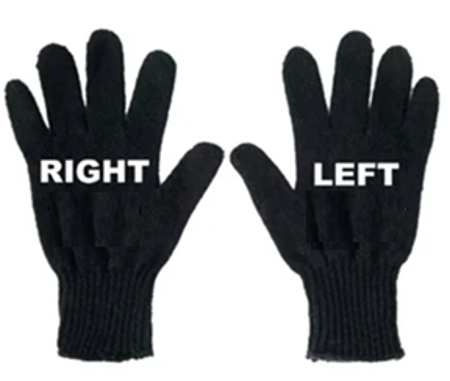
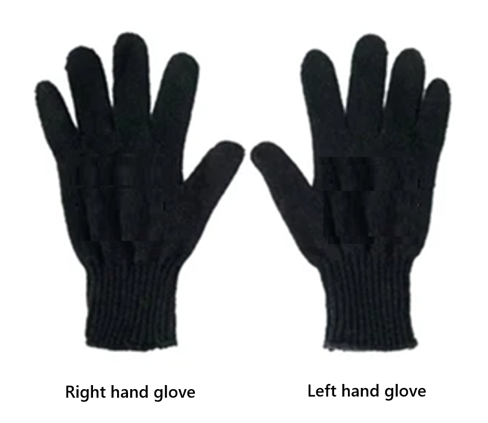
The above representation shows a pair of gloves. While the shape and configuration of the gloves can be considered a mirrored form, the wording right and left are visual features that result in different overall appearances and as such represent two designs. If the intention of this detail is to signify labelling, wording such as right hand glove and left hand glove should be clearly placed underneath the representations.
Example 2: Earphone
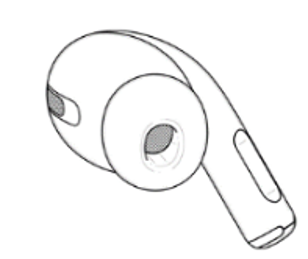
In cases where only one item from a pair is represented in an application, such as a single earphone, the design may still effectively protect both items if the second item is visually identical except for orientation. For example, if the left and right items of a product are mirror images of each other, the design registration for one item can extend to the other by implication. This is because the visual features are the same, and the mirrored orientation does not introduce new or inconsistent visual features. Applicants may choose to also include a mirror image view to clarify and demonstrate that the design applies equally to both items of the pair, without having to apply for a separate design registration for the second item. This view serves to illustrate the other half of the pair without suggesting a separate design. The mirror image should be clearly labelled, visually identical except for its orientation, and should not introduce any new or inconsistent visual features.
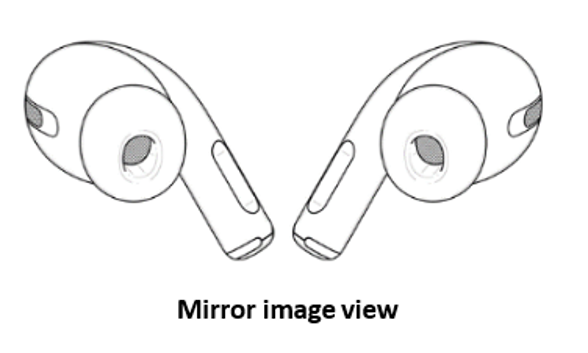
This representation reflects the left and right orientation of the earphone. There is no inconsistency in visual features, and a single design is therefore shown.
Amended Reasons
| Amended Reason | Date Amended |
|---|---|
Minor adjustments to page. |
|
Minor formatting update. |
|
Minor update to page title. |
|
Page reviewed and information updated. |
|
Minor clarification regarding pairs. |
|
Clarification |
|